Category: Uncategorized
We are delighted to invite you to the 46th Annual Society for Mental Health Research (SMHR) Conference, taking place from 25 to 27 November 2026 in Ōtautahi Christchurch, Aotearoa New Zealand. Significantly, this year’s conference is co-hosted with the Australasian Society for Bipolar and Depressive Disorders (ASBDD) with the aim of strengthening collaboration between our societies and the broader research and clinical communities.
The theme for this SMHR-ASBDD Conference is “Weaving Connection and Knowledge”, which represents our commitment to bringing together Indigenous knowledge and Western scientific approaches to improve mental health outcomes. The conference will unite clinicians, researchers, and people with lived experience from across New Zealand and Australia, including members of SMHR and ASBDD.
By connecting perspectives and sharing knowledge, we aim to shape treatments, systems, and supports that address the biological, psychological, social, and societal factors influencing mental health. Central to this work is ensuring that long standing inequities in mental health outcomes are confronted and that care is accessible, culturally grounded, and effective for all.
We are honoured to host SMHR-ASBDD 2026 in Ōtautahi Christchurch, a place of deep cultural, historical, and environmental significance. Our venue, Te Pae Christchurch Convention Centre, stands as a symbol of the city’s regeneration, an anchor project in the rebuild following the Canterbury earthquakes.
Te Pae’s design reflects the region’s mountains, braided rivers, and vast plains, and sits in an area that has long been a home, food gathering place, and trading hub for Ngāi Tūāhuriri and Ngāi Tahu, the mana whenua of the region. Gathering here gives us an opportunity to acknowledge the land, honour its stories, and learn from the Indigenous knowledge systems that continue to shape wellbeing in Aotearoa, alongside weaving connection and knowledge from Aboriginal and Torres Strait Island peoples and perspectives.
Located in the heart of the city, Te Pae offers easy access to cultural, retail, and dining precincts, along with art galleries, museums, and green spaces. The wider Canterbury region also offers breathtaking natural landscapes and activities for those wishing to explore.
SMHR-ASBDD 2026 will feature a full programme supporting students and emerging researchers, including:
- Symposia, free papers, and poster presentations
- Travel grants and carer fellowships
- Discounted registration for students
Please share this announcement with your colleagues and networks.
We look forward to welcoming you to Ōtautahi Christchurch for SMHR-ASBDD 2026.
Be sure you are a current member of SMHR or ASBDD to receive membership benefits and discounted registration fees!
Registration fees, accommodation, social functions and booking policies are available here. With multiple events taking place in Christchurch during this period, we recommend booking your travel arrangements early.

Sincerely,
Co-Convenors
Professor Sarah Hetrick (SMHR)
Dr Maree Inder (ASBDD Co-chair)
Associate Professor Aswin Ratheesh (ASBDD Co-chair)
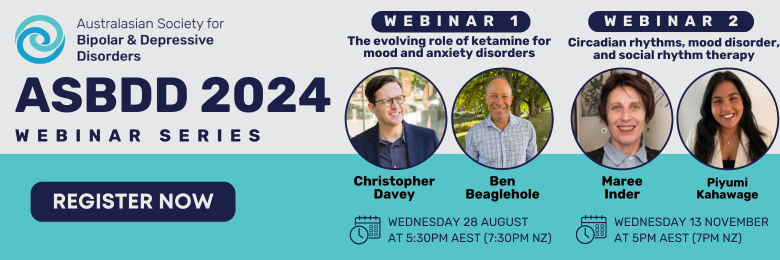
The Australasian Society for Bipolar & Depressive Disorders (ASBDD) wishes to invite you to the ASBDD 2024 Webinar Series! We have two webinars lined up for 2024 on some interesting topics. Please see what we have in store for you!
The webinars will be recorded in case you want to attend but are busy on the day.
Webinar Details
Webinar 1:
Time: 28th August 2024 (5:30pm AEST, 7:30pm NZST)
Speakers: Christopher Davey and Ben Beaglehole
Topic: The evolving role of ketamine for mood and anxiety disorders
Webinar 2:
Time: 13th November 2024 (5:00pm AEST, 7:00pm NZST)
Speakers: Maree Inder and Piyumi Kahawage
Topic: Circadian rhythms, mood disorder and social rhythm therapy
For more information, fees and to register, visit https://mers.cventevents.com/event/ASBDD_2024_Webinar_Series/summary
The impact of COVID-19 on people with depressive disorders.
Two years into the pandemic, a sizeable body of research is emerging to suggest that it’s taken a heavy toll on those already diagnosed with a depressive disorder
Words: Paul Merrill
Depression is a complex mental illness with a myriad of causes, not all of them fully understood. But among some of the most common triggers are experiences that have become widespread during the pandemic.
Reduced social interaction, loss of employment, disruption to routines, enforced working from home, strains in relationships, loneliness and concern about the future have had a significant impact on mental health. The Australia Bureau of Statistics found in July 2021 that one in five Australians were suffering high or very high levels of psychological stress because of COVID-19, with women, young people and those with a disability the hardest hit. Overall, 21.8 per cent more mental health-related services were processed nationally than during the same period in 2019. Studies in New Zealand reported similar findings.
Lockdowns also led to increased alcohol intake, weight gain, less exercise and financial pressures, all potential precursors to anxiety or depression.
A growing crisis
A raft of academic studies around the world sought to explore the extent of the crisis:
- University of Calgary researchers collated 29 studies of more than 80,000 children and revealed that the chaos, fear and disruption associated with the coronavirus had caused cases of depression and anxiety to double, with those who had the conditions already struggling the most.
- Spanish researchers analysed the results of 12 major surveys into mental health during COVID and found rates of depression were seven times higher than before its spread, and that those affected were less likely to seek help than the general population.
- A 2020 report on adolescents by Turkish academics concluded that the fear of being infected with COVID can trigger intense feelings of anxiety and depression and cause sleep disorders, loneliness and anger. It can also worsen symptoms of OCD.
- A third of interviewees in China and Japan reported developing severe anxiety during COVID, with half suffering moderate anxiety in a 2020 research piece. Similarly, studies have found that fear of contracting the virus leads to intense emotional and behavioural consequences such as boredom, loneliness, anxiety, sleep problems and anger (Brooks et al. 2020).
In Australia, the first two years of the COVID pandemic led to a significant spike in the number of people seeking help with their mental health, with the charities Beyond Blue, Lifeline and Kids Helpline all reporting more demand for their services in 2020 and 2021 than in 2019. A raft of studies found heightened levels of psychological distress in the general population, though no rise in the number of suicides.
Does COVID exacerbate pre-existing disorders?
The increased prevalence of depressive disorders has been well documented, but there has been less research into the impact on those diagnosed prior to the outbreak. If the societal effects of COVID cause more people to become depressed, does it also exacerbate pre-existing symptoms?
A major 2020 review of the psychological consequences of travel restrictions, prolonged curfews and mandated isolation in several pandemics found that depression, paranoia, psychotic disorders and PTSD were all more likely to occur to those who had previously experienced mental disorders.
Researchers at the University of Otago in New Zealand found that a third of those with a pre-diagnosed mental disorder had experienced more severe symptoms during the COVID lockdowns, while they were twice as likely to report moderate to high psychological distress. The 2021 study also found they were three to four times more likely to have suicidal thoughts.
An Australian survey of youth mental health with pre-existing mental health difficulties found that 75% indicated that COVID had a negative impact on their mental health. Similar results were seen in the UK in 2020, with 80% of respondents indicating the pandemic had made their mental health worse. Importantly, the same group in 2021 found that 67% felt that COVID would have a long-term negative effect on their mental health.
Greater infection risk
A less predictable finding was that individuals with mood disorders such as depression and bipolar disorder are more than twice as likely to become seriously ill or even die when infected by the virus. A paper published in JAMA Psychiatry in August 2021 processed data from 91 million people and discovered no difference in infection rates, but a massive variance in the effects on the body.
“Mental illness is a pre-existing condition putting people at very high risk of this terrible virus,” one of the report’s authors, Professor Roger McIntyre told The Health Report.
One possible explanation is that depression can take its toll on the immune, metabolic and sympathetic nerve systems. Those affected are also more likely to suffer from heart disease, respiratory illnesses and diabetes.
It’s worth noting that the analysis was done long before Omicron became the dominant variant, with milder symptoms than Delta.
Lesser effects on bipolar disorder
People with bipolar disorder may be coping better with the pandemic than those with other depressive disorders, according to analysis of 14 research papers by an international group of academics. In some of the studies, those with bipolar disorder actually had lower rates of relapse, less severe psychiatric symptoms and higher feelings of wellbeing than before the pandemic. They also reported lower levels of distress compared to those with depression.
However, that wasn’t the case in every study they examined. In two research projects conducted in Melbourne and Michigan that compared those with bipolar disorder to healthy controls, the participants with bipolar disorder experienced worse cognitive symptoms, more stress, sleep difficulties and anxiety. An evaluation of bipolar disorder cases in Italy found elevated levels of work-related stress and anxiety related to financial difficulties.
One major US study found that a recent bipolar diagnosis made it more likely that person would become infected with COVID, while another reported that bipolar individuals feared the virus to a greater extent so wore masks and worked from home more than the general population. Several of the researchers have called for more studies on the subject to better understand the full picture.
Self-help strategies
The best advice for anyone who thinks they may have a depressive disorder – whether linked to the pandemic or not – is to talk to their doctor or report to the emergency department of the nearest hospital. But, despite a range of highly effective treatment options being available, many never seek help, sometimes because they dismiss their feelings as too trivial or because taking positive steps seems too overwhelming.
Several organisations have published self-help advice on how to deal with symptoms and reduce anxiety levels:
- Healthline.com released a list of 12 things to manage depression during COVID including seeking social support, practising mindfulness and taking advantage of teletherapy.
- The Psychiatric Times published six tips that include healthy eating, engaging personal coping skills and staying connected with friends and family.
- Berkeley’s Greater Good Magazine recommends seeking professional help, meditation and finding planning small activities that allow for a moderate amount of pleasure and/or accomplishment.
Hope for the future
Though the last 24 months have often seemed bleak, there is mounting evidence that the worst may be over. Australian National University’s COVID-19 Impact Monitoring Survey has measured levels of psychological distress throughout the pandemic. Although periods of lockdown and increased infection caused sizeable rises (particularly for women), levels had returned to pre-pandemic levels by August 2021.
Will the trauma and stress we’ve experienced make us collectively more resilient, and better at coping with adversity? There’s evidence from several studies to suggest that might be the case. A study by the University of Buffalo concluded that negative life experiences can make people better able to manage subsequent difficulties.
The pandemic has certainly led to a renewed focus on wellbeing, work-life balance and looking after those in need.
It’s still too soon to speculate on the long-term consequences such as how many of those newly diagnosed with depressive disorders will recover and whether those who experienced more severe symptoms will see them ease.
The ASBDD is the pre-eminent Australasian forum for research into these debilitating disorders to improve outcomes and quality of life for those living with them and their caregivers. The vital work the society facilitates has never been more urgent or important.
Studies show efficacy of telehealth for treating depression.
Prolonged lockdowns led to a surge in mental health phone consultations and therapy sessions via Zoom. But can mood disorders really be successfully treated over the Internet instead of face-to-face?
Words: Paul Merrill
It’s been well documented that the months of lockdowns and heightened financial vulnerabilities caused by COVID-19 led to a surge in the number Australasians seeking help for depressive illnesses.
But the crisis also forced a seismic shift in the way mental health is treated, arguably the biggest in decades. Instead of sitting opposite their psychiatrist or psychologist for weekly therapy sessions, many patients found themselves in their lounges in pyjamas either talking to them over the phone or staring at their blurry image over Microsoft Teams.
In the first year of the pandemic, nearly a third of those who sought help with a mood disorder had at least one such appointment.
They weren’t alone. The Australian government expanded its telehealth service within days of the first lockdowns so anyone could speak to their GP or a specialist without leaving their home. By the end of 2020, it had logged over 54 million calls from 13.5 million people, costing the treasury $2.8 billion.
And it wasn’t just popular when strict travel restrictions were in place – the phones continued to ring off the hook when restrictions eased as people realised how convenient it was, especially in remote or rural areas.
In December 2021, the government bowed to pressure and announced it was here to stay, pledging $106 million over the next four years to cover GPs, specialists, nurses, midwives and allied health services. Consultant physician and specialist services would be merged into a single program nationally.
A national telehealth service had been established in New Zealand in 2015 and proved popular from the start with 550,000 enquiries in its first year alone. During the first week of lockdown in March 2020, the number of calls increased by a third, most related to stress, anxiety and depression.
The country’s largest telehealth provider, Whakarongorau Aotearoa, meanwhile saw daily call numbers rise from around 800 a day before the pandemic to up to 40,000, many more than they were equipped to handle.
Persuading the gatekeepers
But it’s one thing chatting to your doctor about a repeat prescription or stomach bug, and quite another when it’s long-term therapy for severe depression. Surely that would be better handled face-to-face?
Some clinicians clearly thought so.
Those surveyed by academics at the Australian National University in 2020 said they feared that building a trusting rapport and picking up on non-verbal communications would be much harder over the phone, potentially resulting in poorer patient outcomes.
But the researchers argued that such fears are misplaced as the evidence they studied from the past 30 years demonstrates that internet-delivered treatments are actually highly effective.
So a lack of advocacy from mental health professionals is an issue as they’re the de facto gatekeepers for implementation. Therefore more needs to be done to win them over.
The report states: “The most widely studied [treatment] is internet-based cognitive behaviour therapy (iCBT), with strong evidence that it is as effective as clinician-delivered CBT for a wide range of mental and physical health conditions.”
Patients seem to agree. A 2021 study co-led by ASBDD co-chair Dr Jen Nicholas found that young people who had accessed mental health services via telehealth felt it improved service quality across eight domains. “The most striking finding”, she says, “was that almost four in five young people reported telehealth made them feel more supported and respected in their care”.
It’s not only individuals switching to online help for their wellbeing. The pandemic prompted corporate Australasia to prioritise employee mental health as never before, with hundreds of firms signing up to an array of telehealth companies that provide counselling hotlines for their staff. One report in 2021 found morale was the single most important issue for jobseekers and that nearly three-quarters would turn down a job if they thought it would make them less happy.
Behavioural activation therapy delivered by lay counsellors
Another 2020 study by the University of Texas in Austin looked into whether low income, housebound adults over 50 with depression experienced reduced symptoms following behavioural activation (BA) treatment from lay counsellors over the phone.
Most of the 277 participants simply couldn’t afford professional psychiatrists so the researchers wanted to understand the relative success of bachelor’s-level, unqualified therapists compared to problem-solving therapy (PST) from licensed clinicians.
The trial, carried out before the pandemic hit, found that both treatments had a significantly positive effect on patients compared to a control group. In fact, BA compared favourably with the PST. The authors argued that using lay counsellors should be considered given the chronic shortages of mental health specialists, exacerbated still further by COVID-19.
Meanwhile an examination of 688 peer-reviewed studies over a 50-year period published in 2021 by a team from the University of North Carolina came to a similar conclusion – that telehealth interventions had a major influence in helping with depression and anxiety. The report was specific to African Americans, but noted that rates of mental illness between races only varied by about seven per cent.
What did vary, however, was propensity to seek help, with people of colour only half as likely to do so. The same is true in Australia where Aboriginal people are twice as likely to experience high levels of distress, but are less likely to seek help. The Mental Health Commission of NSW blamed the reluctance on cultural insensitivity and a fear among parents they’d lose their children if they admit to a mental health problem. It’s another area where telehealth has an important role to play.

Blended mental health care
COVID has presented a unique opportunity for Australia to transition towards a blended mental health care model with digital therapies complementing face-to-face consultations. So says leading mental health research group the Black Dog Institute. In fact, such a scheme could alleviate the chronic shortage of mood disorder treatments that means half of those with disorders aren’t receiving any treatment.
“The pandemic has been a driver of increased suicide risk and increased demand for mental health services placing further pressure on the existing system,” the institute’s 2020 paper on the subject states. “Traditional in-person care faces ongoing barriers to meeting demand including a limited workforce, the location dependency of treatment, and out-of-pocket costs.
“Blended digital mental health care offers a future-focused solution, combining elements of face-to-face treatment and digital therapies. There is strong evidence that digital solutions are clinically effective in reducing mental illness.”
Acting director Prof Sam Harvey said in 2021 that the industry had been waiting for the technological breakthroughs that the pandemic has provoked for decades.
Orygen’s MOST platform is an example of blended-care brought to life through COVID. The online mental health platform with evidence-based therapy, a peer-moderated social space, and support from clinicians, peer workers, and vocational workers, was funded by the Victorian Government to be embedded within the state’s youth mental health services from mid-2020. With services struggling with demand during COVID, Prof Mario Alvarez-Jimenez said in 2021 ““The dream is that young people will get the help they need when they need it and for as long as they need it.”
Suicide prevention and wellness organisation Beyond Blue also supports more telehealth provision, but identified some key barriers for patients that need to be overcome:
- Worry about the technology involved.
- Feeling unsettled about where to take the call.
- Thinking their concerns are too trivial.
- Being daunted by the change in routine.
Clinical psychiatrist Olympia Athanasopoulos gives advice on overcoming each of these on the Beyond Blue website and says: “It’s important to remember that, while the method of consultation may be different, the person you’re consulting is the same. My experience so far has been that people are prepared to reveal information about themselves faster or open up more, possibly due to the physical protection of being on a screen.”
Need for further research
It’s a view shared by Dr Katie Douglas, co-chair of the Australasian Society for Bipolar and Depressive Disorders (ASBDD), who believes the service has become a lifeline, especially for those living with mood disorders in isolated areas.
“The pandemic has shone a light on the lack of access to mental health services that many Australians and New Zealanders experience,” she says, “so the increase in telehealth has made a considerable difference. Although more research is needed to assess its efficacy verses face-to-face interactions, there’s no doubt that it has a major role to play in combatting depression and requires continued funding.”
Such funding will be critical as, though the body of evidence supporting its use for depressive illnesses is overwhelming, not every study has been able to make a direct comparison to in person therapies. One that did precisely that was meta-analysis of five controlled trials by the Institute for Evidence-Based Healthcare at Bond University, Queensland. It revealed that there were “no significant differences” between the two for treatment of anxiety, depression and obsessive compulsive disorder.
It’s still too soon to judge what the medium or long term effects of the pandemic will be on those with depressive disorders, or how long it will continue to disrupt their lives. But what is clear is that, whatever happens, telehealth will have a key role to play and studies should continue into exactly how that role should play out.